
The Corset
by Laura Purcel
Genres Historical, Depressing, Racist
1.5/10
Ruth Butterham is in jail awaiting judgement and execution for murder. She is visited by Dorothea Truelove a rich and privileged woman studying phrenology and sees in Ruth the opportunity to prove her phrenologic theories right. In this process, Ruth recounts the tragic and according to her supernatural events that led her to jail leaving Dorothea questioning both Ruth’s sanity and her culpability.
Highlights
- Racist and arguably transphobic moments
- Half the story has the reader following a detestable protagonist
- Some chapters are pure filler
- Soul crushingly depressing
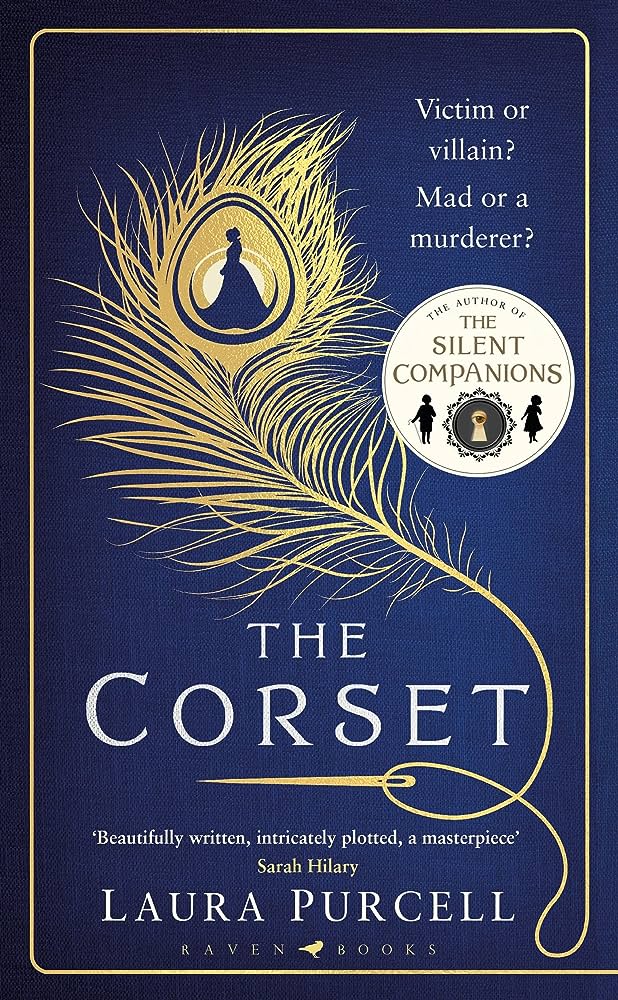
I like corsets, that’s really all it took for me to pick this book, I went to my local Waterstones and just looked through the store until I found something that seemed interesting. Usually I’d go through my usual picking process of looking through goodreads, the storygraph, and reddit suggestions, checking the overall ratings and maybe even read a couple spoiler free reviews if I’m still unsure. This time all I had was what Waterstones was advertising, the cover, and the blurb; I did have a quick check on Goodreads and it rated at a nice 4.1 so it at least didn’t seem like a universally awful book (then again Fifty Shades of Grey is rated at a 3.7 over there so I know Goodreads ratings to be taken with a scoop of salt). Nevertheless, the cover was pretty, Waterstones had it on a “great crime books” table and the blurb was…fine. It didn’t completely grasp me but I really like corsettry and books set in the romanticised victorian era so it seemed worth the gamble…it wasn’t.
The Corset is a mediocre and depressing slug of a read. The story alternates between the point of view of the suspected murderess, Ruth, and a girl of the high society aspiring to be a scientist, Dorothea. Let’s address the issues on Dorothea’s side of the story first who is a convinced phrenologist. For the uninitiated, phrenology is a pseudoscience attempting to associated skull shapes with mental faculties which played a significant role in giving racism a seemingly scientific justification which is obviously extremely wrong and. Dorothea thus comes out as someone endorsing racism not only as a belief but as a scientific right which makes her entirely despicable. It is in one way, very historically accurate for the victorian times I suppose but the author does not paint her as a bad person nor is her passion for phrenology even presented as morally and ethically dubious. With this book having been written in the 21st century I am forced to wonder about the author’s intentions and beliefs here.
Either way, half of Dorothea’s chapters are spent on her ravings regarding hers and phrenology’s correctness whilst the other half are spent on how miserable she is because she is expected to behave like a lady of the high society. Admittedly, being a woman 150 odd years ago was not exactly great as societal expectations had them usually married off to whatever man would lead to the best financial return for the family. Dorothea however benefits of the luxury of her father giving her a fair bit of leeway in terms of who she wants to marry and when, whilst also benefiting from the white and rich privileges making her “misery” feel more like the whinings of a spoilt child than something I could really empathise with. She simply struck me as dislikable, unrelatable, and uninteresting, so much so that in the second half of the book I started skipping a few of her chapters as I simply got nothing of value out of them neither narratively nor emotionally. Yet, somehow this did not impact my understanding neither of her character nor of the story as a whole. By the end of the book, her character had remained unchanged as did the state of the world compared to the beginning. Having chapters that were seemingly flat out useless to the story is not something I’ve often come across and really makes me question whether the author had a plan when writing this story.
Finally going back to Ruth, her story is a bit more interesting but it is slow and dragged out for what it really is and it is also soul crushingly depressing. There is no levity to be found in her story at all. It is one continuous series of horrible events one after the other which include themes such as poverty, slavery, abuse and child death just to name a few. It is my assumption that Dorothea’s chapters were meant to bring the levity or at least the breath of fresh air needed to balance out the book but as previously explained, I found myself preferring skipping those chapters and stay with the depressing Ruth than spend any time with Dorothea which should go a long way to show just how mind boggingly awful Dorothea’s character is.
Closing off this review, I need to mention that one character is written in such a way which could be interpreted as transphobic where their crossdressing is represented as being abnormal and a sign of mental illness. I do not want to make any assumptions on the author’s genuine intentions especially on such a serious topic but even if accidental this is uncomfortable to read and simply poorly introduced especially when combined with the half endorsement of a racist science.
In the end, I’m just left disappointed and honestly a bit sad that what was supposed to be a fun “let’s go pick out a fun looking book at a local shop” turned out to be a horrifyingly boring and depressing slog…and I really wanted to like this book promising to be a victorian thriller about the possibly magic corset killer…