
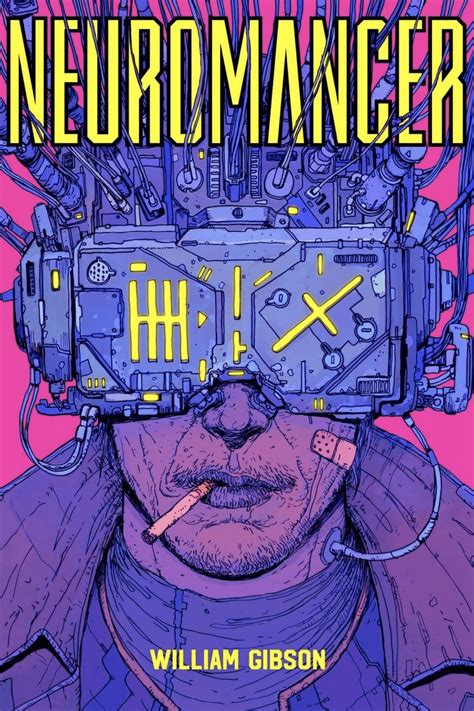
Neuromancer (Sprawl #1)
Genres Heist, Cyberpunk, SciFi
4/10
Henry Case is a data runner and thief whose implants were fried after trying to steal from his employer. He is unexpectedly recruited for a high risk run against an AI owned by the Tessier-Ashpool corporation in exchange for the restoration of his data running capabilities. However, he is in a race against time as in addition to his new implants, capsules of toxins are slowly dissolving in his blood to hold him to his mission.
Highlights
- The codes of the Cyberpunk genre are very present
- Overall, a very typical heist story
- Most descriptions are vague to a fault
- Somehow neither the story nor the world are presented in an interesting way
Fresh off reading the Cyberpunk 2077 world book and finishing off a playthrough of the game including its newly released DLC, I was still on a Cyberpunk high. Both my partner and I had this book on our reading lists and with Neuromancer being one of the founding stones of the Cyberpunk genre, it also allowed me to cross off one of the classics I felt I needed to read. Before reviewing the book itself, a note needs to be made regarding the amount of elements Cyberpunk 2077 seemingly carbon copied from Neuromancer. Every piece of technology, world structure and even some significant story elements found in Neuromancer are identically present (although under an ever so slightly different name) in Cyberpunk 2077. I’ll hold off on condemning Cyberpunk 2077 for its apparent world building laziness and praising Neuromancer as for all I know Neuromancer could have copied its whole world from “Do androids dream of electric sheep” which I haven’t read yet but the amount of similarities raises a few eyebrows either way.
Similarities aside, Neuromancer tells the story of Case, a data runner who under the orders of Armitage and with the help of a razor girl named Molly and a construct named Dixie need to break the black ICE of an AI called Wintermute at Teshier-Ashpool. If you’re wondering what half of those words mean, that’s normal, and that’s how Neuromancer is written. William Gibson does not introduce the reader to its world, instead he throws them in the midst of it where unknown nouns, verbs and names are thrown around and it is up to the reader to pick up on the contextual clues to understand what’s happening.
The upside of this is that the story does not take long to get going, right from the start things are happening and the story is moving forward. There is no lull introducing the technology or the politics of this world, however there is also no opportunity to introduce the characters. That latter part is what hurts Neuromancer the most. Not only is it extremely confusing as no relationship is ever made clear, it also makes caring about the characters difficult. One example is that Case used to have a wife he still misses or mourns for (again unclear which one it is for a long time) yet he also has sex with Molly who then however also simultaneously behaves like their relationship is purely casual but speaks as if they were in a more serious relationship.
This vagueness problem also extends to the wider world and it is an exercise in tedium to figure out what is happening especially during rich in action chapters. Sometimes the issue lies with the arabesque like descriptions that take too long to get to the point whilst also saying profoundly little. Sometimes the issue is simply that the reader is kept in the dark; one character posses a holographic implant allowing them to create hallucinations for people around them. This is a key element of who that character is and it takes the book way too long to plainly state that he has this technology which makes several chapters very confusing as implausible things seemingly happen out of nowhere.
With neither the characters nor the world being ever clearly presented, I found myself getting annoyed as the chapters went on. I never connected with any character as half of the time I wasn’t even sure who was who, and I never got to care about the story’s outcome as both the motive for the heist and its execution were completely unclear to me. I’ve never experienced a stronger feeling of “Ah ok then” than when I was reading the last chapter of Neuromancer. After spending the whole book being artistically vague, including the penultimate chapter which was such a confusing jumble of words that I wasn’t sure whether the heist had even succeeded, the very last chapter’s language is surprisingly plain.
Spoiler
The heist was a success, Molly is…kicked out of the story for the lack of a better word as she is simply gone and excused by a post-it note, Case’s toxin capsule problem was solved essentially magically in the matrix and Dixie was killed off screen.
The last sentence, which I assume reveals Case’s future past the book timeline, is the exception here being flowery, vague and open to interpretation again.
At the core, my reviews are subjective, and my partner whilst also puzzled at times has been left with a much more positive impression than mine (with the caveat that a second read would be necessary to really understand the story). As such I can’t say Neuromancer is bad, it’s a classic for a reason, it clearly sets up most codes of the modern day Cyberpunk genre and it has the foundations of an albeit typical yet solid heist story. I simply did not get into a reading rhythm with it at all and it was way more effort to read than what I got out of it was worth.