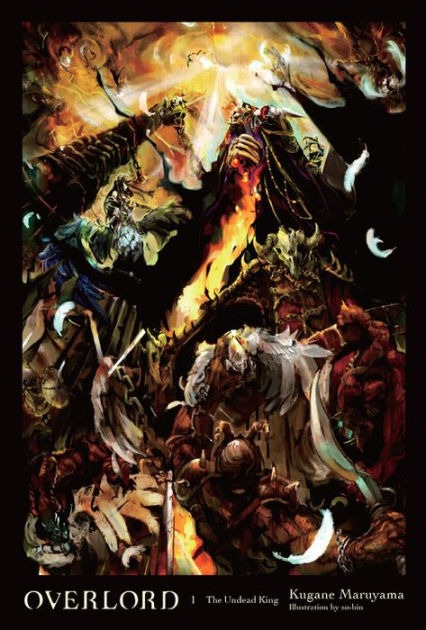
Overlord Vol.1: The Undead King
Genres Light Novel, Fantasy, Video Games
1/10
Satoru Suzuki, a veteran MMORPG player is transported into the game’s world unbeknownst to himself. He finds his character power level directly translating into him being the most powerful being in this world and as its new overlord, he must find new purpose in this new state of being.
Highlights
- Translation is poor and awkward
- Exposition and descriptions are too long and lack purpose
- Paedophilia is endorsed in this book which I cannot condone in any shape or form
- The book unfortunately confirms every one of my negative preconceptions about the anime genre
As outlined in my rating system, giving a book a rating below 2 out of 10 entails that I didn’t pick the book myself as such books should ring alarm bells for me just from their genre or blurb and Overlord is one such book. Itt came heavily recommended by a friend of mine whom I decided to humour, but it unfortunately did not work out and it confirmed every one of my fears when it came to the “anime” genre (encompassing light-novels, manga, and anime).
Japanese media as a whole can struggle with translation issues regardless of format. Between social and grammatical nuances as well as words that simply don’t exist in English, it can be challenging to translate a piece of media when preserving the style loses all meaning but preserving the meaning loses all style. There is unfortunately no way to describe Overlord’s translation other than bad, mostly reading like a high-school student’s attempt at writing formal English when it didn’t read like the output of machine translation. Surprisingly there was a relative lack of typos as I’ve seen native English books written with more spelling and grammatical mistakes than Overlord.
Nevertheless, the book was unpleasant to read as almost every sentence had structural issues, stumbling over weirdly constructed sentences and awkward word choices. In a way, it read similarly to fan-made anime subtitles, the translation effort being put into literal translation rather than putting much effort into style. Whilst it is bearable for subtitles in a show or movie where the acting helps support the message, it is more difficult to stomach for lengthy descriptions and exposition in a book.
This leads into next issue of Overlord which is unfortunately another Japanese media quirk: the overabundance of exposition negatively affecting pacing. Exposition is necessary in any story and in books it can be more challenging to follow the “show don’t tell” rule when everything is written down whereas in film one can directly show on screen without any words. Additionally, some authors do tend to indulge in lengthier descriptions than average such as Tom Clancy’s in-depth explications of military equipment. However, in the case of his books, these descriptions pay off as the understanding of how a thing works becomes important when that thing breaks in the next chapter, they are also so detailed that they can become instructive.
Unfortunately, anime as a genre does none of this as it is a trope to have the protagonist stop all action to deliver an internal monologue to unnecessarily describe the situation they are in when the viewer could just see the situation and Overlord does this too and then some more. It goes through explaining the rules of the MMORPG the protagonist is playing and mentions it having over a thousand races of which the author describes 12 before throwing the protagonist into a world in which most of MMORPG world rules do not apply. On top of the exposition having no pay off, a lot of the information feels random, the number of races, classes, spells, items all range from the thousands to the millions which seems absurd when World of Warcraft, a 20 year-old MMORPG with a 35 year-old lore only has 26 races.
In another cliché of the genre, these descriptions are also repeated. The author will narratively describe an item, e.g. “this is the sword of the god of war who has slain his father and forged the blade from his blood” followed by the protagonist seeing the item and in dialogue saying out loud but to himself “so this is the sword of the god of war who has slain his father and forged the blade from his blood”.
This overindulgence of descriptions extends to more action focused parts of the narration which is felt particularly when the protagonist is fighting off a group of adversaries. The protagonist is exponentially more powerful than their opponents, there is no chance they can lose, and the fight should be quick and decisive, something the writing should reflect, ideally with short sentences and a rapid chain of events. However, in once again, a very genre clichéd way, this battle takes the better part of a 45min chapter because of the added descriptions and never ending in-combat dialogue.
The ultimate issue is that the book is not very long, barely reaching 250 pages, but with this abundance of dialogue and descriptions that do not serve story progression, there is very little left of substance. The saving of a village and the follow-up are the only two real events of the book and they only occur in the last third of the book, the first two being dedicated to exposition. Even more painful is the way the book ends on a very abrupt cliffhanger, giving a taste of unfinished and the impression of the author arbitrarily deciding that this is where this chapter would end and that they’d pick it up in the next book, making Overlord unable from standing as a novel on its own.
However, a worse issue crops up when considering that the large amount of exposition does not prepare the reader in any way for the events to come. At some point, a chapter suddenly jumps away from the protagonist to other characters in the world the protagonist got transported to. Names, locations, plans, stakes are all being discussed before jumping back to the protagonist who does not yet know he’s been transported to another world…and neither does the reader, making this cut away from the protagonist feel like it came from a different book altogether.
Finally there is the sexism and paedophilia issues which need to be addressed and are unfortunately yet another trope of the genre and were the key reason behind my stopping of watching anime. The immediate attention and too long descriptions of women’s breasts, the strictly male vision of what a woman in love should behave like and the sexualisation of a child character who was designed to be a “sexually attractive child” because their creator was “a bit of a pornography expert” (which is a direct quote from this book) are simply unforgivable. Anime and manga might get away with it because the legal grey area of “lolicons”, but a novel does not when it uses the word “child”.
The book has its occasional amusing moments and there is a concept in it that I could find fun if it had been better written but if From Blood and Ash which had me genuinely interested in its first 90% deserved a 2 out of 10 for its glorification of rape in its last 10%, then Overlord does not deserve anything higher than a 1 with its casual use of paedophilia and overall lacklustre writing.