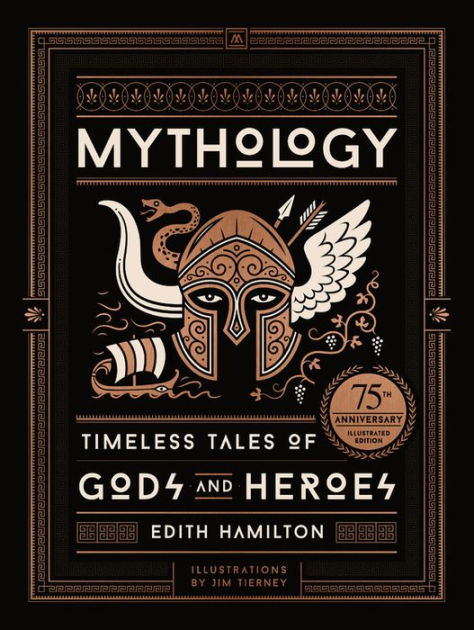
Mythology: Timeless Tales of Gods and Heroes
Genres Mythology, Classics, Fantasy
8/10
The Ancient Greek and Norse mythos are the inspiration of many modern stories and even today most people still know who Achilles or Odysseus were but few have the patience or the desire to read through the Illiad or the individual poems of Ovid. In this collection of ancient stories, Edith Hamilton delivers a modern retelling of stories everyone knows of but few have read.
Highlights
- A great way to revisit and learn more about the Greco-Roman myths
- Most stories have aged surprisingly well and can still be enjoyed without needing a literary lens
- The coverage of Norse myths is disappointingly brief in comparison
- Some aspects of Edith Hamilton’s writing feel a bit dated
I mostly read my books on my Kindle, it’s a practical format that handles better than books as I don’t need to make sure to keep the page I’m reading open, it doesn’t need an additional light when reading at night and it saves me from having to buy a separate bookshelf to keep a bunch of pocket sized books I’ll never read again and whose cover are too boring to count as decoration. Mythology isn’t like this though, it’s a beautiful large book with few but nonetheless incredible illustrations on the inside, conversely it relating to the ancient myths of Greek, Roman and Norse times, reading about them on paper felt right.
Beyond the aesthetics, I have for a long time wanted to read through classics like the Illiad, however, my attempts at approaching greek mythology through the likes of Circe and The Song of Achilles had left me unimpressed when I wasn’t outright disappointed or annoyed at how unnaturally the story progressed. Greek and by extent Roman mythology is dramatic in its truest sense and it isn’t kind to women who are often the target of the worst of fates or abruptly killed off or written to suicide, it is difficult to bring about such actions in a convincing manner and as controversial as that is, I don’t think these aforementioned spruced up retellings of the myth of Circe or the Illiad succeeded in that.
Mythology bypasses these issues by offering a more direct and accurate collection of these stories. Edith Hamilton uses her own words to tell these stories but only in so far as to translate and modernise the language used by the original writings of the ancient Greek and Roman authors, no liberty in altering the sequence of events is taken. As such Mythology doesn’t quite read like a modern novel, it’s drier, stylistically sitting somewhere in between the plot summary from a Wikipedia article and a real novel and it works. The stories are all still interesting and aside from the obvious dated sexism coming from them their adventurous nature still excites. Mythology is a brilliant way of learning what actually happened in almost every myth and legend of that time and exposes how much liberty we take nowadays in telling the stories of the war of Troy or Hercules’ tasks. From Shakespeare’s Romeo and Juliet not being an original story to Hercules not being quite as revered as I thought to the origin of mundane plants and animals like spiders, sunflowers and black crows being all linked to Gods’ bad nature this collection is an amazingly digestible eye opener.
Reading through it in one sitting might not have been the best choice however, whilst it mostly reads like a collection of short stories, some parts lean so heavily into the description side of things that there is little fun to be found in it and it feels more like a school assignment especially so when before each section, Edith goes through her thought process of which authors to source the stories from. These parts are arguably what age the book most, whilst the writing is more modern and than a literal translation from the original texts, it is still 82 years old now and some references and sentences feel dated as they presume a literary knowledge that might have been normal for 1942 but doesn’t apply to today, but this doesn’t take anything away from the actual stories being told.
A more difficult point to ignore is the disproportionate focus on Greco-Roman mythology over Norse mythology. It is pointed out that little is actually known about Norse mythology with most of its texts having been destroyed by Christians but coverage of it in this book only takes a generous 20 pages with the remaining 320 purely focusing on Greco-Roman myths. It is entirely possible that in 1942 there really was so little known about Norse myths and that new discoveries since then have padded out our modern knowledge of them but as it stands, the Norse mythology inclusion feels like a bit of an afterthought here.
Mythology is nonetheless worth the read, it’s a difficult book to rate, giving a score to something like the Illiad feels a bit absurd given the dramatic changes in culture and writing style since its original conception, but as an entertaining educational book, one could not wish for anything better.