
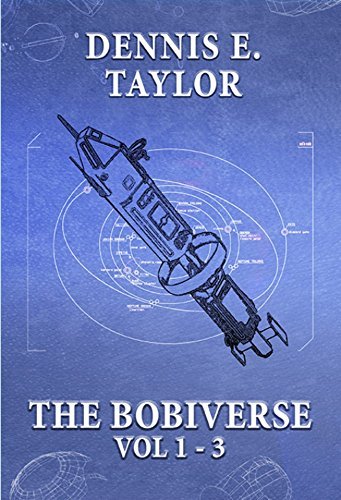
The Bobiverse Series (Books 1-3)
by Dennis E. Taylor
Genres Science Fiction, Comedy, Light-hearted
9/10
Having had his head frozen to be revived once technologically had caught up, Bob didn’t expect his revival 100 years later to come with so many strings attached. Humanity finds itself in another cold war fuelled space race and Bob’s consciousness transferred to a computer is meant to be a replicating robot exploring space for North America. Enforced servitude was not the afterlife Bob was hoping for, but maybe he can find a way of wiggling himself out of this situation and take to the stars with a newfound sense of freedom and purpose.
Highlights
- Just plain fun.
- Structure is a bit lacklustre, the 3 books should be seen as one.
- A lot of minor unfinished plot-lines sadly
- Another series that should have stopped at book 3.
I really wasn’t expecting to love The Bobiverse as much as I did, the drive behind me picking this book up was that the audiobook happened to be read by Ray Porter, the narrator for the excellent Project Hail Mary whose rendition of the book I loved to bits. The premise was interesting enough, guy gets revived as a sentient computer and gets to explore the galaxy but the name “Bobiverse” or even the title of the first book We Are Legion (We Are Bob) pushed me away; it’s silly in retrospect but there’s just something about the name Bob that feels like the set up to a low effort joke. Whilst this was mostly disproved thankfully, some bits of this series do lack a bit of maturity.
First things first though: the concept. It works. There is a bit of hand-wavy explanation going on with some aspects of the technology used, and some aspects are only explored in the most surface level way to avoid putting too much existential dread into the story (I’m thinking FTL communication and the discussion around identity with Bob making conscious copies of himself) but it’s just enough to not feel like huge plot holes. This is definitely helped by the fact that were it not for Bob’s clones, the book would be a bit boring. The Bobiverse doesn’t tell a story, it tells around 5 to 7 stories which each progress independently with often little interaction aside from the Bobs catching up with each other once in a while. With the exception of one none of these stories on their own are interesting enough nor explored in enough depth to make a full book but by splitting them up into alternated chapters, it keeps giving a “just one more chapter” feeling.
Spoiler
- One story follows Bob-1 overseeing the evolution of a sentient species on another planet
- One story follows Ryker/Will attempting to save the survivors of Earth
- One story not particularly tied to any Bob revolves around the Bob-Brazilian probe war
- One story not particularly to any Bob revolves around the Bob-Others war which should have been the focus of the trilogy
- One story follows Howard and his relationship with much shorter lived humans
- Individual Bobs can have brief arcs and the overall story is held together by Bill acting as central contact for all other Bobs.
There is a bit of frustration with that organisation and story telling choice as it can be both a bit difficult to follow and leads to several plot lines seemingly going nowhere. The story takes place over 100 odd years and the chapters each identify, the narrating Bob, the system it takes place in, and the year. Unfortunately, due to the nature of some stories taking place over the full 100 years and others only taking around 50 years to complete, the chapters don’t follow each other chronologically. As such it can be a bit confusing to have a Bob get blown up by an enemy vessel in one chapter, only for the next chapter to be about some casual planet terraforming because it’s taking place 20 years before the Bob got blown up.
This sort of leads into the next issue: the book really skirts around the philosophical and existential questions of Bob’s existence. Original Bob, as in the alive human one, chose to have his head frozen because he is deeply convinced that there is no afterlife and he is terrified of death. This fear of death however is not carried over to replicant Bobs, whilst they are able to backup themselves before being killed/destroyed, it is understood that fundamentally the restored Bob is a different Bob, not a straight revival of the Bob that died. Yet whenever a Bob dies, it is handled with a lot of levity which clashes with the terrified of death Bob from the beginning. This problem also feeds into the identity issue brought by replication, Bob does overtly say “better not to think about it too much” (hello Tenet) and with the slight changes of personality coming with each replication, it’s easier to excuse but each newly replicated Bob seems to too easily deal with the fact that he might have the identities of up to 7 different Bob replicants before him.
It is however consistent with how static Bob’s character is, despite the personality changes for each replicant (so that we can have an OG Bob, an angry Bob, a techy Bob etc) none of them ever show growth. In part this is due to the author heavily relying on Bob being “a bit of a loner”, he doesn’t particularly care for human interaction and with one exception seems to have no desire for companionship which means that most of the time Bob is interacting with either literally himself or just another Bob. This was fine for me but I know people online have not taken kindly to this because if Bob’s original personality isn’t your thing then the book essentially becomes unreadable and by the end of book 3 the lack of growth was starting to grind my gears too. Bobs regardless of personality always make the same jokes, have the same set up (I cannot over empathise how many times I had to read a sentence like “I plopped down in variant of a bean bag description and got a coffee from Jeeves” every single time a Bob goes to talk to another Bob) and the same pop culture references. Speaking of which, there’s too many pop culture references, this is giving Richard Osman’s Thursday Murder Club a run for its money in number of needless references. Where TMC was laying it on way too thick with references to British culture (It’s only Sainsbury’s but it’s Taste the Difference), every single character from Battlestar Galactica, Star Trek, Star Wars and whatever obscure 90s cartoons gets a mention, it’s infuriating because it puts so much focus on how little personality original Bob has: he’s a nerd, that’s it.
Yet, there was a suggestion of conflict and growth with some Bobs calling humans “Ephemerals”. Bobs being immortal, their perception of time and relationship with mortals is obviously affected and when the term “ephemerals” is introduced by generation 3+ Bobs as a derogatory term for humans, it’s frowned upon by the older Bobs and it’s even suggested that some form of intervention will be needed if this were to continue as the threat of Bobs seeing humans as racial inferiors is a problem. This doesn’t go anywhere though, halfway through book 2, most Bobs use the term ephemerals once in a while and it’s kind of a thing, the conflict just never happens.
A similar issue pops up with generational ranking, this goes back to the author refusing to talk through the identity issue but in book 3 it’s abruptly introduced that generation 8+ Bobs feel inferior to older Bobs referring to themselves as “pond scum” and feel the need to prove themselves valuable. There is no precedent for older Bobs being superior or even thinking negatively of newer Bobs, there is the implied suggestion that new Bobs use their creator Bob’s VR environment as a communication hub but there is no military style hierarchy nor even order giving system. As such this pseudo conflict of sense of worth neither has a set up nor does it somehow manage to go anywhere. The two Bobs used as case study of the feeling of inferiority get to become famous and that’s it, the generational feeling of worthlessness is never mentioned for anyone else.
Still moving along the problem of not dealing with defining identity is the issue of Howard. Howard is for some reason the only Bob who values human companionship so much so that he wants his friends and love interest to become replicants to live with him in VR. Living humans however have much stronger hesitations in regard to the technology. Unlike Bob, they really struggle with endorsing the idea of their consciousness being copy pasted into a replicant and not cut pasted. This goes back to the philosophical question of if your body died, would the copy of your mind be original you or not? Once more however, this doesn’t go anywhere, it never leads to Bob questioning his own identity and why he’s ok with it when almost no other human is. There even is a racism subplot about humans feeling like Bobs’ existence is unnatural and unwelcome, but in a broken record type way I have to say this doesn’t go anywhere. With Howard’s story there is one case study again of this racism affecting him but Bob-racism is otherwise never a problem in the grander scheme of things and there are things happening in the grander scheme of things, introduce The Others.
The Others are a hive mind controlled alien species who are reaping (word choice intended) the metallic content of neighbouring systems and in doing so annihilating every form of life sentient or not. They are more technologically advanced than Bobs which leads to several gruesome moments which are the series highlights, despite its mostly light-hearted, pop culture reference filled tone. The Bobiverse does occasionally go to dark places helping with the story feeling a bit more mature than it really is, because its execution certainly isn’t. The Bobs lose against The Others, repeatedly so and by the midway point of book 3 there still isn’t a clear way of winning. Yet the entire threat is resolved within 4ish chapters of one battle and even the victory is due to sheer luck which ironically makes this a deus ex machina. It really feels like the threat of The Others wasn’t planned out nor that it was taken as seriously by the author as it should have been. The Others storyline is allocated as much space as Howard’s story of trying to make his girlfriend a replicant or as much as Bob-1’s story of hanging out with primitive aliens for fun. Yet The Others are threatening the destruction of humanity which should be slightly higher priority and given the technological gap, the story should have been given more space to develop.
Going back to the word reaping, The Bobiverse should have taken the Mass Effect story structure with the first book/game focusing on establishing the world and introducing the threat of the reapers at the end of it, the second one beginning the fight against the reapers but there still being time to get sidetracked on secondary storylines and the third one being fully focused on fighting the reaper threat. Instead The Bobiverse keeps its even split between each story and the resolution of The Others threat is underwhelming and a bit undeserved. More than that though The Bobiverse doesn’t really care about book numbers, all three books just continue one into the other, there is no clear break, you could merge books 2 and 3 together and I wouldn’t notice that book 3 started, as such it’s better to see The Bobiverse as one big book instead of 3 individual ones.
This was a lot of me criticising but in the French “qui aime bien châtie bien” which translates to “who loves well, punishes well”, I loved this series, I look forward to listening to the audiobook, it’s going up there with Project Hail Mary for one of my favourite science fiction stories and that’s why I wish it was better. A lot of the issues just seem to stem from poor organisation or poor forethought which seems supported by the fact that all three books came out in under 2 years which seems too short a time between books to properly organise the story. Surprisingly though, something that went above and beyond despite the time constraint is the vocabulary, I have never had to look up so many words in a book and admittedly often they were US specific expressions but nonetheless, it was nice to have a book where I felt like I was learning some new English.
Strictly speaking a lot of my issues might be resolved in book 4 because there is a book 4 and a book 5 on the way. However, there is more time between the release of books 3 and 4 than between the release of books 1 and 3. Book 3 also ends with a “The End” and books 1 through 3 are grouped together in a special edition called “The Bobiverse”. Book 4 is clearly an afterthought and not even a necessary one as escalating from the threat of The Others can only feel forced. As such just like the Red Rising saga I prefer to stick to my head cannon that the story ended with book 3 and keep my positive opinion of what I read instead of digging for disappointment in an unnecessary sequel.