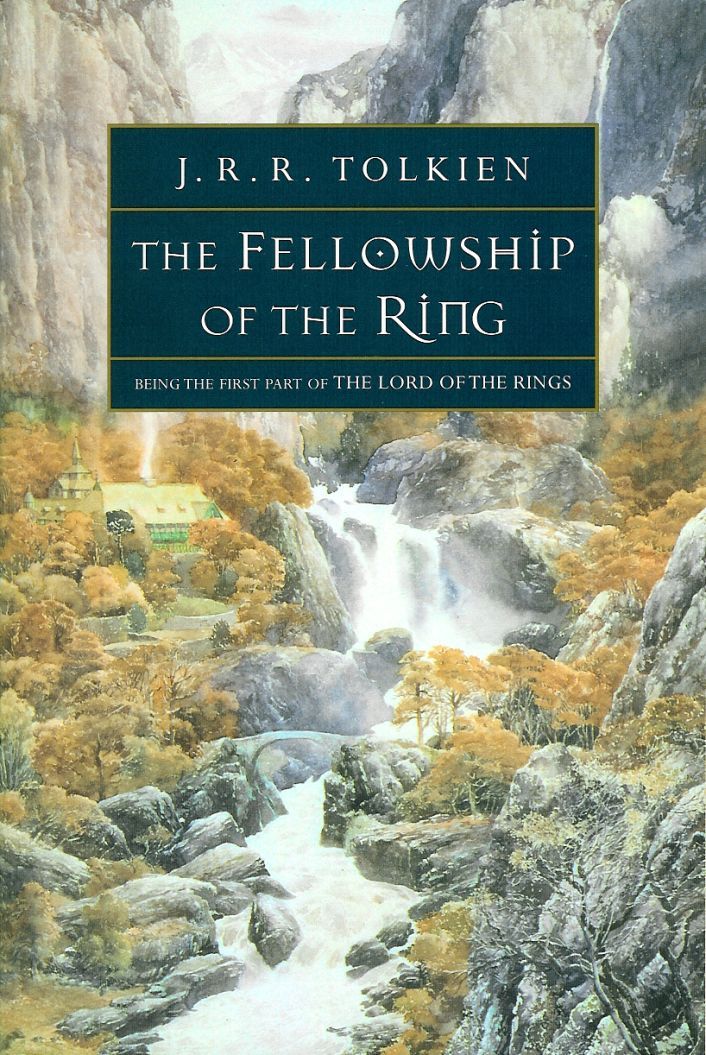
The Fellowship Of The Ring (The Lord Of The Rings #1)
Genres Fantasy, Classic, Adventure
9/10
In the land of Middle Earth, Frodo Baggins a Hobbit inherits an unassuming ring from his uncle Bilbo. His friend the wizard Gandalf however uncovers the ring’s true origins and power and Frodo is thrown into a grand adventure that might even surpass his uncle’s adventure with the dwarves.
Highlights
- Like The Hobbit, this is a story better told than it is read
- The depth of the world is palpable at every step…
- …but this comes at the cost of pacing and sometimes even entertainment
- It isn’t strictly better than the movie nor is it strictly worse
I finished 2024 with The Hobbit and I’m starting 2025 with The Fellowship of The Ring and that’s something. The Fellowship is a book I have tried reading in the past once and tried listening to twice and I had never made it past Elrond’s council. Its slow and meandering pace didn’t keep me engaged supplemented by the lack of any real action. The Fellowship is a book about people talking and walking, even when fights or any faster paced action occurs it is usually glanced over if not entirely skipped and it is with a bit of shame that I must admit that I don’t enjoy that, I like a bit of proper action and a good fight scene. However, I have now completed it and whilst some flaws still remain, it is undoubtedly a lot better than I had any memory of albeit good in a very different way from the movie.
Speaking of the movie, The Lord of The Rings trilogy is my favourite set of movies of all time by a comfortable margin and I’ve rewatched them once or twice every year for the past 10 years at least. I am more than happy to say that reading this first book has not in any way soured my opinion of them. The usual adage is that the book is always better than the movie as the book doesn’t have to restrict itself to a set length and gets to explore character personalities, story beats and background lore in much more depth than the movie is ever allowed to and this is still the case here but what the movie loses in depth it gains in pace and arguably character interest. Before getting back to that point the reason I mention my love of the movies is that I am intimately familiar with the storyline and this might have somewhat dampened my experience reading the book as I didn’t really discover this world and story more so than I simply learnt a bit more about it. However, another aspect comes into this: I listened to the audiobook read by Andy Serkis as much as I read the book myself and I strongly believe that the book simply wasn’t written to be read but rather to be told.
As I mentioned the book is almost painfully slow to start and only gets to a regular slow pace by about the midpoint and so reading in my head, it felt very monotone. Going through details like hobbits’ family trees and detailed landscape descriptions is amazing to paint a picture and I can say that Tolkien deserves a lot of credit for truly making me see what he describes in my imagination but I also think that it is nicer to paint a picture with spoken words and the associated emphasis of speech than it is to read a lengthy description in one’s head. This also extends to the dialogues which can be as lengthy, descriptive and use as overly flowery language as the narration and once again this turns into monotony when reading in my head but gets transformed into a grand speech by Andy Serkis in the audiobook. I think I might have wholly enjoyed my reading more if I had read it out loud even just to myself (although my partner would probably have happily listened to my bad voice acting) but the book is too long for that to be practical.
Upside of the depth of those descriptions, dialogues and…songs and poems is that along with giving a clear picture of the world, they also showcase the depth of Tolkien’s work on world building in the background. From the prelude presenting the History (note the capitalised H) of hobbits to the backstory of the old war with Sauron to poems and songs delivering in universe well known stories and myths it is once again – as it was in The Hobbit – very clear how much effort Tolkien put into this world and makes it all the more painful how little effort most fantasy authors have put in since. That almost every aspect of modern day fantasy is derived of a small subset of Tolkien’s work was something I was already aware of but reading this book has made it obvious that saying “almost” is maybe even too generous. From the standard set of fantasy races and their associated characteristics to the structure of a Dungeons and Dragons party to the fantasy myths to the “evil that we do not name” which would usually be associated with Harry Potter to such simple quotes as “All who wander are not lost” that have all been transformed through the years to the point that they don’t even acknowledge inspiration from Tolkien anymore can all be traced right back to this book and that is both incredibly humbling but also awesome in its most traditional definition. I have soured on most modern fantasy stories because they lack depth. I don’t care about some random elf lord who has ascended to become the god of war because he defeated a large evil army of orcs because I know the author hasn’t thought much past that anyway, the elf fought orcs some long time ago and that made them a god and that’s it. I just cannot be bothered to learn a whole new set of deities and pseudo-cultural traditions that are only valid for a couple of books and are all derived from Tolkien anyway even if the authors themselves aren’t aware they’re being derivative. I went into The Fellowship wondering if I’d get that same feeling eventually, but not only is the feeling of depth consistent throughout the book, Tolkien goddamn managed to make me want to know more. I read a poem about Gil-Galad and instead of throwing it away in a corner of my mind as a disposable bit of knowledge, I felt that I wanted to learn more about him and that is a first for me when reading fantasy and the best part is that I can because Tolkien put in the work (hell if I wanted to, I could learn his entire family tree from the creation of the world because that was necessary apparently).
The inevitable downside is the pacing really gets brought down by this. If you’re reading The Fellowship to find out what happens to Frodo and the ring you’re going to be waiting a long time as you go through each poem, song and description on the way and nowhere is this worse than in the Tom Bombadill chapters. The Bombadill chapters really make me question how my past attempt at reading the book went because despite making it past his chapters I had virtually no memory of them and yet going through them again now they are by far the worst aspect of the book. I would rather read five additional chapters about hobbit family history than read another line spoken by Bombadill. It’s difficult for me to say who’s more at fault for my hatred of the character, whether it is the way he is written as an overly jovial, overly singing and overly powerful entity who is the only aspect of Tolkien’s world that doesn’t really fit in nor make sense or if it is the way Andy Serkis voice acts for him. Either way however, the Bombadill chapters are a perfect example of almost every negative aspect I can find in the book: they’re slow, they include way way way too many songs and they do not move the story forward at all. Bombadill’s character also seems to powerful, the ring having no influence on him, he could have chucked it into Mount Doom himself and everything would have been a lot easier. He does not fit into this world and Tolkien seemed to have known this as he’s completely left behind after his chapters are done.
Whilst Bombadill’s chapters are heavy in singing and poetry so is the rest of the book and as much as I can enjoy them for the lore and stories they tell, I cannot really abide by their sheer quantity. Regardless of cultural and historical justifications, there’s just too many of them and every single character gets his song or poem moment. Not only do they slow the pace down again because the prose and syntax is more difficult to follow than regular narration, they are also plainly not fun to read in your head. Silver lining is that this does give credence to my hot take that the book is better told than read.
Every character having their singing moment leads me into another negative point although this one is quite a soft one: all characters merge into one another. The movie does something with the characters that removes depth from them but makes them more memorable: Frodo is mild-mannered and grim, Sam is brave and hopeful, Pippin is simple and enthusiastic, Aragorn is noble and serious, Legolas is elegant and powerful, Gimli is gruff and boisterous, Gandalf is old and wise etc. I can immediately tell you what each character is about when remembering the movie which is not quite the case of the book. Just as every character gets to sing, every character gets to be brave, every character gets to be sad, serious, cowardly, funny, annoying and so on. On one hand this can be seen as the characters being less cliché and behaving more realistically in a way but on the other it also makes them all a bit less special. Not all changes are positive in my eyes mind you, I find farmer Maggot’s role as an almost off-screen mean guy in the movie a waste given his positive role in the book and making Gimli a rough around the edges cliché dwarf for comic relief definitely takes away from his character but overall the memorability of the characters is much stronger in the movies. Even the bad guys are more…plain in the book, Nazgul are still dark riders but instead of being a difficult to fathom ethereal menace, they’re just some guys on dark horses in the book and that is a bit boring frankly.
Keeping with the movie comparison, the movies also added a lot of small memorable moments that I felt were truly missing in the book. The Fellowship isn’t assembled because Aragorn, Legolas and Gimli volunteered themselves, they were chosen by Elrond which again goes against giving them a stronger character. Arwen’s character is essentially absent despite a poem being dedicated to her. The Moria passage is missing quotes like “it’s not a mine, it’s a tomb” or key moments like Frodo being the one who solves the riddle instead of Gandalf or the “proud Gimli moment” at the reveal of the mythril shirt (the moment does occur eventually but it is nowhere as impactful as the movie’s, facial expressions for once transmit a lot more than any words Tolkien used). Part of the issue might be that the pacing suffers a sudden shift when Frodo reaches Rivendell and whilst it is still slow by any measure, it is when compared to the first half, blazing fast. To put some numbers down, the stay in Rivendell took me around 3h to read through but once the fellowship gets on its way, in less than 2h30 they get to the Caradrhas mountains, walk back from it to Moria, go through Moria and fight their way out. Am I bothered that Tolkien wrote too quickly and do I think he should have the second half slower than he did? Maybe…as weird as that is coming from me.
Nevertheless there’s still some really strong moments in the second half that outshine or at least equate the movie’s rendition. The Balrog in the movie is impressive but I think this is a case of the unknown being scarier than anything else. The Balrog in the book is that unknown, his descriptions are vague something that is noticed given how Tolkien wrote descriptions so far and his impact on every character is felt, he’s not a big horned devil with a whip, he’s an incarnation of evil itself that even ancient beings like Gandalf and Legolas fear. Oh and the ring is cool too. Despite being called The Lord of the Rings this first book reveals preciously little about its real power until the very last chapter. Hints are given at its powers throughout the story but they are mostly neutral or even positive effects. Yes, Gollum was consumed by his desire for the ring but Bilbo and Frodo enjoy some nice longevity, it helps them hide from trouble, it even helps Frodo see better in the dark and then comes Boromir’s breakdown. Boromir attacking Frodo for the ring in the movie was brilliantly acted by Sean Bean and the book and audiobook renditions are all on par with it. They are all equally strong in their own way and it is a sudden shift showing the real power and threat of the ring. It is also followed by Frodo’s anguish filled experience wearing the ring for a slightly longer period of time and experiencing for the first time in full the mind altering effects of it. It’s a perfectly described and fittingly scary experience and whilst I’m split on whether it comes in a bit late or if it’s a good way of demonstrating the insidiousness of the ring, it is still very memorable.
Rating The Fellowship of the Ring is difficult. I’ve enjoyed my time with it a lot more than I thought but it is doubtlessly alleviated by having listened to a significant portion of it. As a pure reading experience it was nowhere near being as enjoyable. I also must maintain that for storytelling purposes the movie does a much better job than the book and whilst I appreciated the additional depth and context provided in the book, it was almost more like reading supplemental material to the movies rather than another way of enjoying the story of the movies. It is however so important for me to empathise that it made me enjoy fantasy in a way I have not before. In any case, I am looking forward to the Two Towers now that all introductions and stakes are done and set up and am hopeful for a smoother and more fun reading experience then.