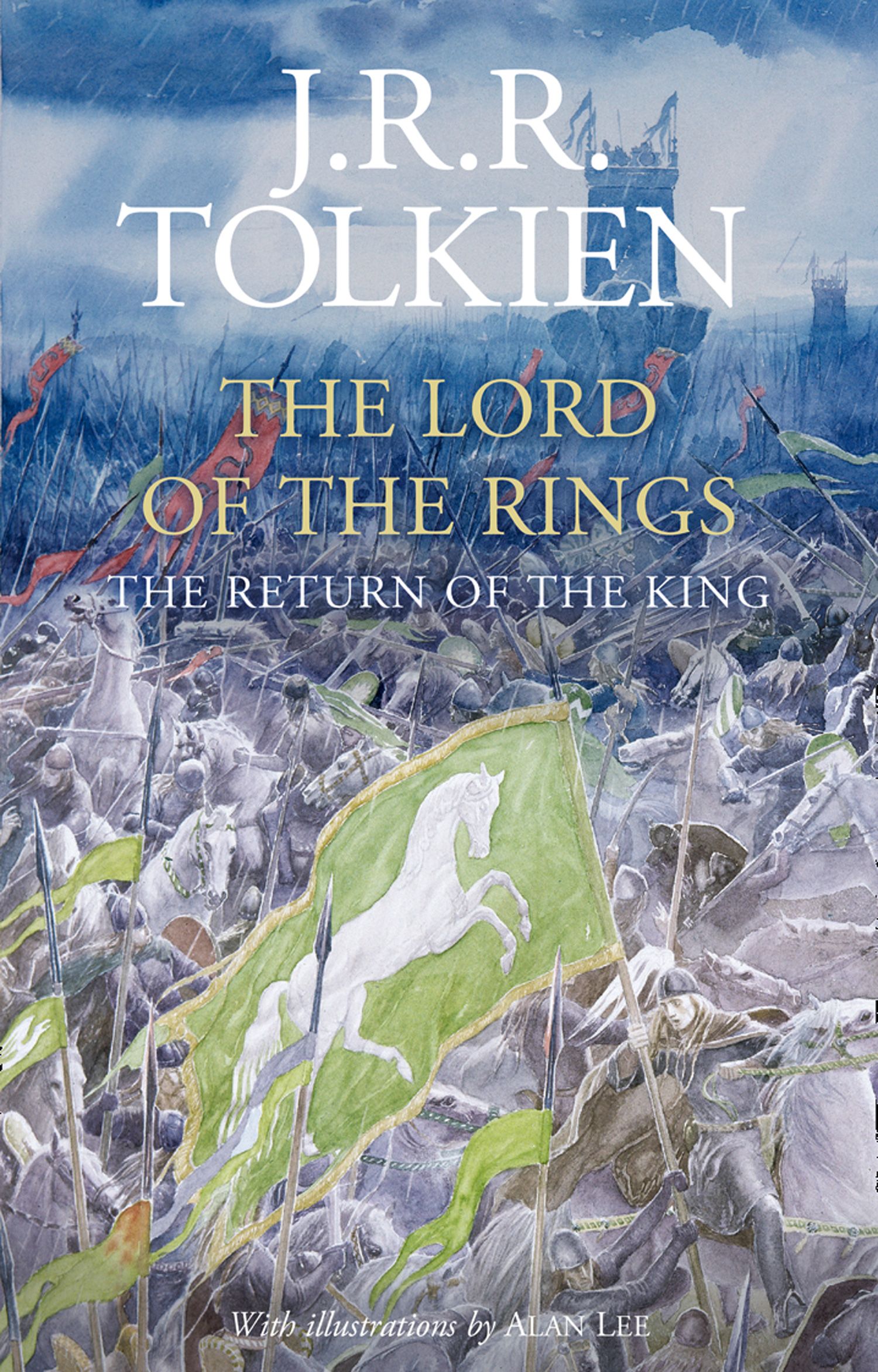
The Return of The King (The Lord of The Rings #3)
by J.R.R. Tolkien
Genres Fantasy, Classic, Adventure
8.5/10
Time is running out for Frodo and Sam to destroy the One Ring as the realm of men is teetering on the edge of destruction and Minas Tirith lies under siege and Aragorn and the armies of Rohan race to the city’s rescue.
Highlights
- Mostly better than the movie for once
- Some slowdown at the half way point
- A perfect conclusion to the story
- But why must it end
There’s not too much I can add at this point following the previous two books, The Return of The King is mostly more of the same in both good and bad ways. Differentiating it from its predecessors however, it has larger differences to the movie and this time the book version does come out on top in a lot of cases. The book opens with us following Gandalf and Pippin as they enter Minas Tirith and many little changes immediately pop up when comparing the book to the movie. Gondor is already calling for help, it is not a result of Gandalf weaselling his way around Denethor. Gandalf is also a lot more pleasant and more understanding of Pippin whereas in the movie he’s always overtly mildly hostile to Pippin which to me always felt off and forced and now it makes sense because the change to their relationship is a movie thing.
Denethor’s character deserves its own section has he is again subtly but significantly different from his movie character. He’s also less overtly hostile here and his madness grows through the book and he is not cartoonishly evil. His hostility and uppity attitude is explained through his connection to a Palantir which is completely absent from the movie. His behaviour is also more in line with the one of a broken father rather than an angry evil man who happens to also be sour about having lost a son. The key difference is what makes Tolkien’s writing special: it is highly detailed. This also extends to Minas Tirith as a whole; whilst visually impressive in the movie, we know preciously little about the inhabitants of the city or how life in it is. In the book we get to accompany Pippin as he walks through the streets and is guided by Bergil, one of the city’s guards who is so pleasant that it is a real shame he was skipped for the movie.
We then jump back to Theoden and Aragorn’s troup and here we go back to “lesser Tolkien” where a lot of time is spent walking and talking most of which is of little consequence. The introduction of Aragorn’s grey company is ultimately of little consequence and is one of the few movie changes that I’d qualify as a net positive. Instead of the army of the dead saving the day as they did in the movie, in the book they simply commandeer some ships for Aragorn and his grey company off screen and then the grey company saves the day at the battle for Minas Tirith. The path of the dead is generally a particularly underwhelming component as it quite literally only takes 2 lines and is then pushed to “off screen”. The chapter instead focuses on Aragorn and his company trekking to the path of the dead including a stop at Rohan’s capital to finally introduce us to Eowyn who’s been very absent so far and it’s a very walk and talk heavy chapter which I didn’t particularly enjoy.
The actual battle for Minas Tirith is around as good as it was in the movie, you obviously lose a lot of cool visuals that movies can deliver but descriptions, dialogues, speeches, character interactions all get a little bit more depth. Special note has to be given to the description of Rohan’s charge and Theoden’s almost godly aura. Eomer taking over mid battle as Theoden dies and delivers the “death” cry is also a nice way of giving the battle a second wind whereas the movie kind of rushes to the end with the ghost army. Gandalf facing the witch king without the lore breaking staff breakage is cool as well. Overall, whilst Helm’s Deep disappointed, the battle for Minas Tirith delivers and then some more. It also benefits from Tolkien writing a song about the battle which anchors it into this world as a significant historical event that enters into legend decades later and is just another testimony to the depth of Tolkien’s world.
Unfortunately the next couple chapters stumble a bit in pacing as the houses of healing and the last debate and very loquacious for very little once more. I appreciate that those chapters give weight to Theoden’s death however, just how the Balrog was more than a big looking demon and Saruman’s voice was more insidious than the movie showed, having characters grieve for Theoden’s death was sad but necessary whereas the movie his death is essentially forgotten in the light of victory. Eomer also gets more emotional depth as he takes over as king and deals with Eowyn’s near death experience. However, there’s otherwise little of note here, some funny interactions with the dubious healers about Aragorn’s healing power as true king, the last debate obviously leads to the decision of storming the Black Gate to give Frodo a chance to finish his task but it’s a lot said and little done.
This is where the story on Aragorn’s side stops and we are meant to just switch back to Sam and Frodo…where are Aragorn and Gimli one might ask, and I asked myself the same question. There is a staggering lack of Legolas and Gimli, they’re technically around but they never say or do anything and in doing so just how I mourned missing Gollum after having seen him only through a handful of chapters, so do I mourn Gimli and Legolas who are all but absent after the end of book 2.
In any case the chapters following Sam and Frodo are decent and I can’t say much more about them. Having Sam carry the ring for a bit we get a more direct insight into the ways the ring influences its wearer but it’s not all that much altogether and it’s also very sudden when we spent the first 2 books with it having done almost nothing. Jumping a bit ahead, we are also completely robbed of a Frodo internal monologue or even a description of the mental anguish he’s going through as he ultimately decides to keep the ring for himself which is very disappointing. In any case, back to the beginning of the second half, Sam saving Frodo is a good chapter, there’s some good humour bits to not be too depressing, it is however then followed by them walking through Mordor which delivers some nice lore in the ways of landscape descriptions and just a general sight of how orc society operates in it but it’s also another one of “walk walk walk” chapters. The last Mordor chapter barring the missed opportunity Frodo monologue, is amazing in describing the desperation to get to Mount Doom and to destroy the ring, Sam and Frodo are on the verge of death but there is no other way of putting it aside from they refuse to die, their commitment to the task is admirable and reinforces their bond even more if that was even possible. The ring’s actual destruction is a bit of a letdown as Gollum just kinda stumbles off into the lava as he rejoices instead of it being a maddened Frodo pushing him off and I’m usually not a fan of divine justice.
And that was The Return of The King…well not quite we still…5?? hours of epilogue. I wasn’t optimistic about that, I was very afraid of it being Tolkien at his absolute worst, tying up every single possible loose end and to be a slog of dialogues of no consequence. I was fortunately wrong although it begins with the chapter of the steward and the king and it’s a weird romance focused chapter coming out of nowhere. Eowyn is suddenly in love with Aragorn with essentially no set up but decides to be with Faramir in the end. Aragorn and Arwen get married, but why? Arwen wasn’t a character in this book, her existence is suggested by Aragorn’s poem in book 1 and she’s briefly seen at Rivendell but has otherwise had no interaction with anyone in the story so Elrond handing off his immortal daughter to a mortal man loses a lot of impact as there was no conflict developed there in the first place.
Follows then a lengthy but surprisingly good walking chapter as the company walks back home and slowly individuals leave as they reach their destination. In doing that Tolkien gives a nice feeling of finality as we get our proper goodbyes with each and every character (even Gimli and Legolas) and even get to go back to Isengard and visit Treebeard where we learn that he allowed Saruman to leave and have a catch up with Bilbo at Rivendell. Left only with our hobbits who enter the shire we reach the very long chapter of its scouring. Before reading it, I thought it was entirely unnecessary, the big bad guy in Sauron has been destroyed, everything is healing, we did our proper goodbyes, it’s time to end the book, suddenly adding a random “oh god our home has been pillaged, how are we ever gonna fix that” chapter felt like needless padding. Surprisingly, it arguably was one of my favourite chapters, there was something very satisfying and almost comfortable in our more mature and rugged hobbits using their experience to tackle a mini adventure and leading the charge for once instead of following, it essentially ended up feeling like a bonus level. It also tied in nicely with Saruman’s escape as he was indeed the cause of the scouring of the shire and his death brings a nice final point to it. I was surprised at how similar his death in the movie is to his death in the book, and in the book it does feel a lot more earned and logical as Wormtongue got a lot more character development. The one downside to this chapter is that it made hobbits into a race that’s also very ready to fight and kill if need be; it’s again logical but brings up the issue of homogeny where everyone gets to do a bit of everything. Small details in this chapter that I enjoyed too, Tolkien’s hatred for post war architecture and industrialisation is palpable as he describes the destroyed Shire and Frodo’s mithril coat gets another use and isn’t just a one time token item.
The Grey Havens and actual last chapter of the book is as perfect as it can be, it’s very mellow and bittersweet as Frodo’s departure takes the hobbits by surprise but unlike the movie it is properly set up with hints at Frodo’s injury at Weathertop never fully healing. The movie essentially replicated this last chapter identically and understandably as it is a perfect final chapter.
I must say I also feel bittersweet at leaving Tolkien’s world behind for now. Despite my many grievances against their pacing, dialogue and walk heaviness, these books had an aura of comfort to them. Tolkien’s love for his world is palpable and radiates to the reader. It creates a true adventurous atmosphere instead of the epic fantasy one the movie was going for and I will sorely miss it.