
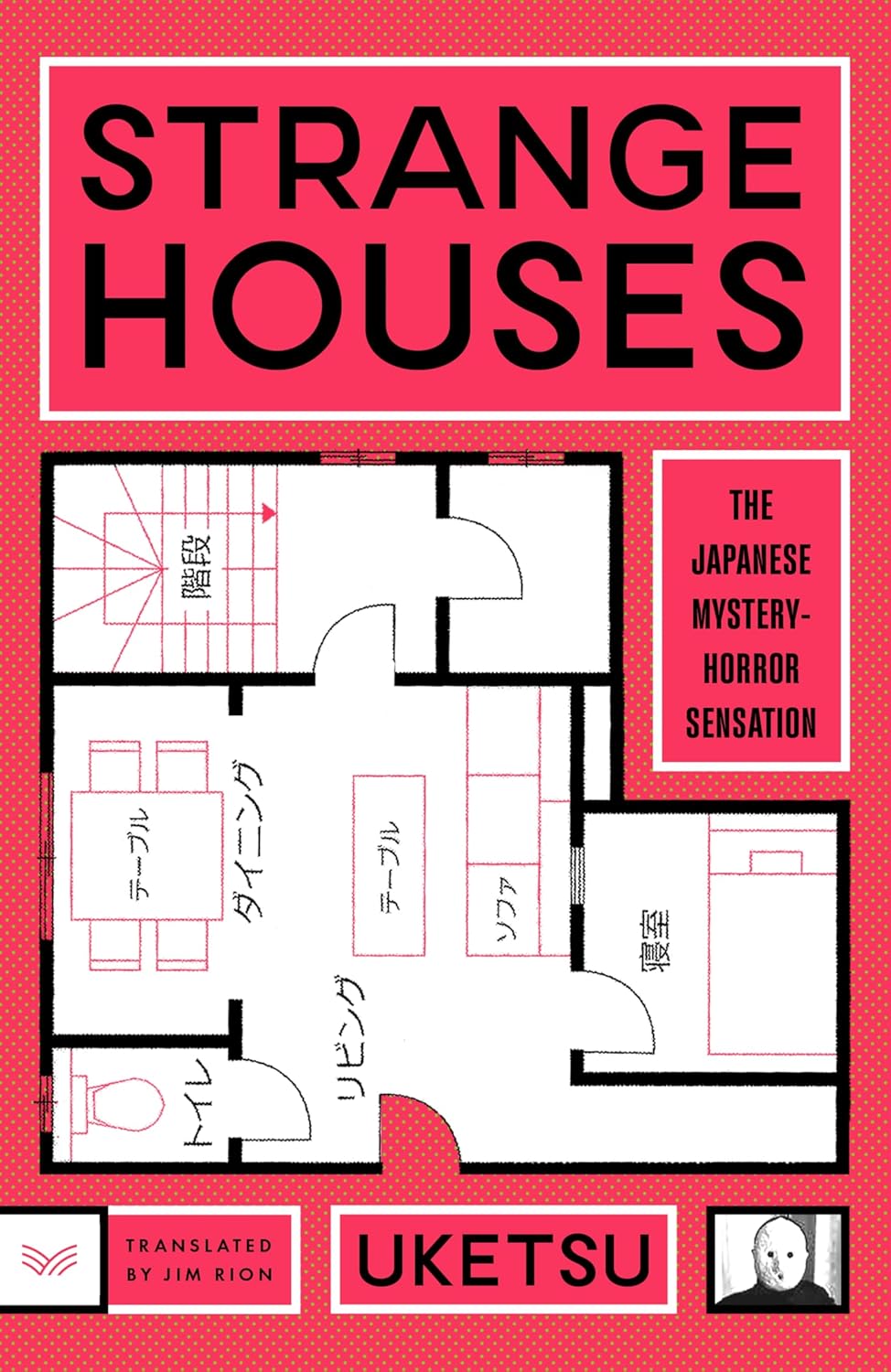
Strange Houses
by Uketsu
Genres Horror, Mystery, Japanese
3.5/10
A mysterious house went up for sale after the news of a nearby murder. Its blueprints however show some irregularities which raises questions in potential buyers. The author and one of his friends become obsessed with these anomalies and go down a murderous rabbit hole.
Highlights
- The premise is based on an entirely baseless jump in logic
- The resolution is based on an entirely uninteresting yet convenient lore dump
- The writing style is awkward and lacks fluidity
- Very disappointing compared to Strange Pictures
I picked up Strange Houses the same way I’d picked up Strange Pictures, I dropped by a library, it looked fun and now I had the precedent of the previous book and so I didn’t check at all what reviews said. Unfortunately, it seems like Strange Pictures was the exception that proves the rule when it comes to me reading books without vetting them first. Strange Houses is pleasant in that I can give it a 3.5/10 without any animosity, it just wasn’t very good but not in a particularly offensive way.
The main issue resides in the premise. Telling a story around the blueprints of a couple houses is a good idea but the only way the author found a way of getting the mystery going is to have a character make a leap of logic so enormous that I do not understand how this made any sense to the author. “There’s a weird space in these blueprints like a hidden room” “Yes you’re right, this can only mean one thing: a child was murdering people in this house that was built specifically for the purpose of hidden murders in the service of contract killers”. I read the whole book hoping that at some point something or someone would show up with a cathartic “Jesus Christ you guys are reaching for some dumb shit here” and reveal the more interesting story behind the blueprints but alas this never happens. The book just plays the murder child story straight all the way through and it turns out to be mostly accurate too.
It isn’t helped by the story or the lack thereof rather. The book starts with the “author”, (I guess we’re meant to believe it’s Uketsu himself recounting some real life events although I never actually got that feeling because of the writing style), helping out a friend with looking over some blueprints for a house they want to buy. “For some reason” (that’s the justification the book gives), they get obsessed with the weirdnesses of these blueprints which leads to the murder child theory which in turns leads to some more blueprint analysis. This is very similar to how chapter 1 of Strange Pictures started, just a character who, as a hobby, decides to look into some odd drawings/blueprints. It’s a fairly clever way of getting into the meat of the subject without really having to build up a story or introduce any precedent. However, in this book this isn’t the first chapter, it’s the entire book. We get no change of perspective or time jumps or character changes that give the mystery a meaty backstory. It really is just the mystery as described by characters lacking any charisma and stakes in the mystery, they’re just looking into it because they can.
Then comes the time for the last chapter and we just get a “lore dump” explaining everything. It’s pretty undeserved as the resolution simply hinges on a new character conveniently showing up at the right time to reveal the whole story. The actual lead investigators of the story did nothing to…well, investigate. They made some theories, reached for some absurd leaps in logic and then another character shows up and says “yes you’re right and also here’s my family’s entire history including all the bits that don’t matter”. There’s no moment where it all clicks into place, which for a mystery is very underwhelming. To stay consistent however the reveal also relies on another incredible leap in logic of “I overheard that a guy missed one singular meeting so I made the logical conclusion that he must be dead which was really convenient since I needed a dead body to scam the family shaman”.
Finally, quick note on the style, it’s very off. We get regular narration but dialogues are presented in the style of a drama piece with each line starting with the name of the character speaking. I realised down the line that it might trying to aim for a journalistic report style and dialogues were meant to be a form of interview. However, the narration also goes over things like “we bought some noodles because we were hungry”, and dialogues, even if seen as interviews, significantly lack in fluidity with convenient progressions like: “you’re asking a lot of suspicious questions complete stranger” “I guess I’m curious like that” “fair enough, let me reveal you details of my personal life” which does not lend itself to a believable journalistic report. There’s obviously a potential issue with the translation as translating any Asian language into English usually leads to some loss of meaning and heavy loss of style but even accounting for that, the style here is simply awkward.
I was never really bored but I was also never particularly interested because of the lack of character stakes and the premise I just never bought into. Nevertheless, and as a last silver lining, the book still manages to have some appropriately creepy and unsettling moments; I might never have believed in the murder child but that didn’t stop me from feeling unease at the author’s descriptions of a child creepily crawling through the walls to find its next victim.