
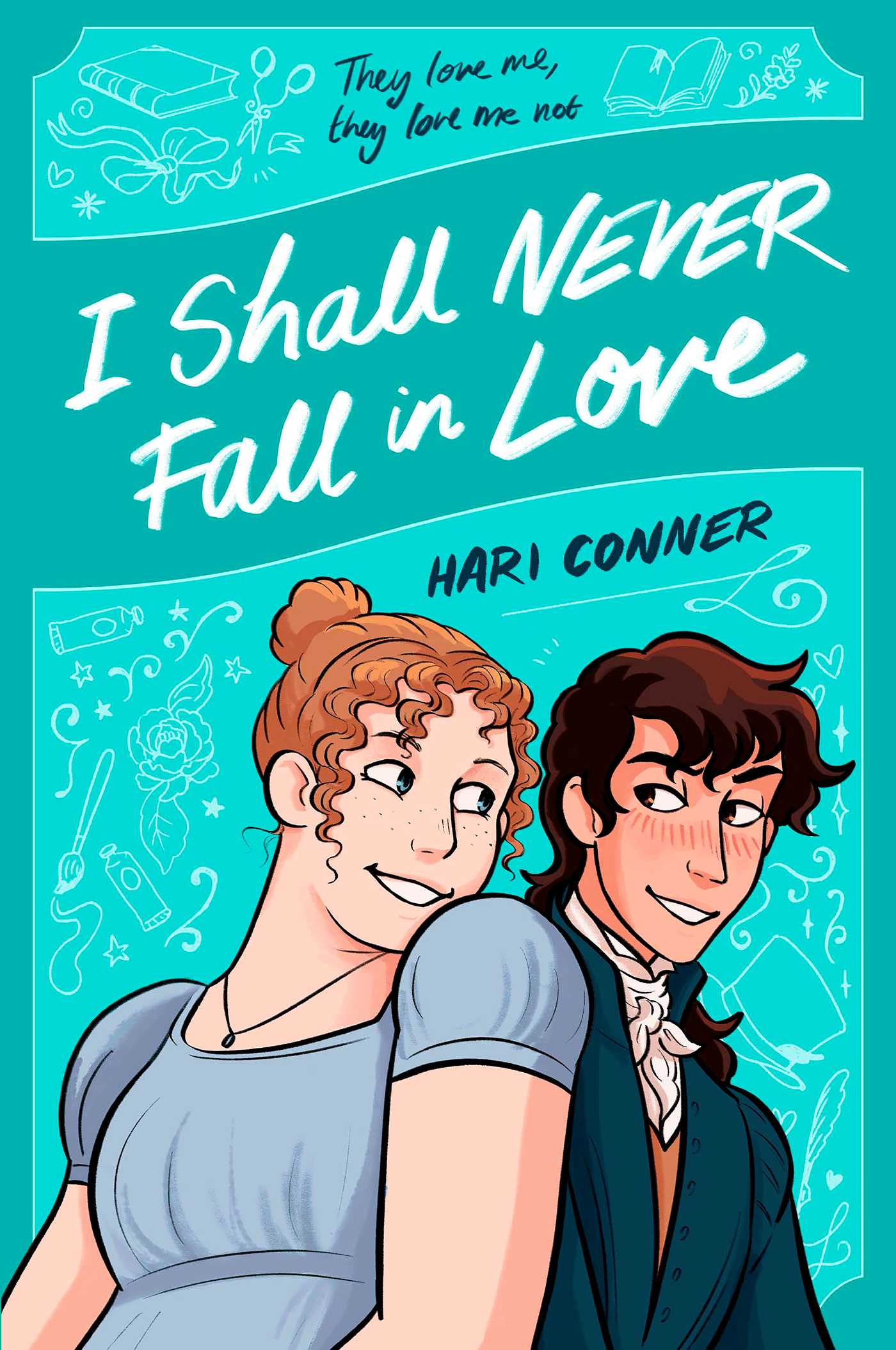
I Shall Never Fall In Love
by Hari Conner
Genres LGBT, Graphic Novel, Romance
4/10
In 1800s Britain, George, Ellie, and Charlotte are inseparable friends. As they approach the age of debuting into society they face the the pressure to conform to its rigid expectations to find a good husband. Yet George cannot imagine themselves marrying anyone, especially a man, when they only have eyes for Ellie. Meanwhile, Charlotte faces a different problem: her future depends on finding a wealthy suitor, an uphill battle given her racial background. Nevertheless, the three friends remain each other’s fiercest allies and they will face down any problem facing them down.
Highlights
- A very profound and resounding “meh”
- The art style is very amateur
- There doesn’t seem to be a lot of thought in terms of story progression
- The diversity feels honestly a bit forced
First book from the LGBT book club I joined and I am going to be a downer because I will be struggling to say anything positive about it. That’s not to say it was horrible but it really exudes “yup this was definitely a book that I read uhuh” energy. My biggest problem is that I’m gonna have to criticise a book that wants to be hyper progressive but the way it does it is so…lazy that I can’t really recommend it for that purpose as I mostly felt pandered too.
Whilst a minor issue, I have a few problems with the art style. The artist heavily relies on cookie cutter character designs leading to many characters having identical face shape and identical body proportions and I often times had to double check who the character actually was. A bit more problematically Charlotte and Ellie would also be indistinguishable if Charlotte weren’t black. I’ve watched some anime, the problem of characters having the same face isn’t unfamiliar to me but anime usually is more liberal with body shapes, hair colours, clothing, etc making characters easy to recognise. This isn’t the case here as the author goes out of their way to explain that they studied up on what real 1800s British clothing looked like but that unfortunately means that everyone also wears the same clothing worsening the issue of everyone looking alike. There’s a scene at a ball where several different male suitors show up and they all looked so similar that I thought they were related (which was not the case). The artist also seems to resort to equally cookie cutter facial expressions and drawing angles which made every frame also look the same. It’s serviceable, it does the job to quickly show you what’s going on but it also lacks any particular flair.
Now for the writing, it’s mostly predictable which also leads to boredom. Admittedly, romances are always predictable in some way, we all read romances knowing that it’ll all lead to a happy ending but usually some conflict or overarching story keeps things interesting which isn’t the case here. Ellie, George and Charlotte are told they need to marry, they don’t find anyone they’d like to marry, George explores their identity a bit, has a fallout with Ellie because they’re so in love but don’t wanna talk to each other (sigh), Charlotte gets a B side story about racial and social rankings, Ellie also gets invested in this by showing her…complicated side, it all turns out alright, the end. The lack of overarching storyline holding everything together causes individual interpersonal storylines to resolve separately and mostly in an incomplete or questionable way. Some story beats also feel quite forced due to an overzealous effort of being inclusive and progressive.
Let’s start with Charlotte’s racial struggle. The book does have a history lesson section at its end which explains that people of colour were living as free people in Britain in 1817 and in some very rare cases a couple even made it to the British high society. What this section doesn’t say is that with the slave trade ban being recent (10 years before the book’s timeline) and slavery altogether still being legal (banned 16 years later), people of colour were still heavily discriminated against and British high society suitors would for the most part not risk their status by marrying a woman of colour. This book has 2 black women and both are heavily courted by many of the white high society men they meet (which is quite odd as they are also still investing in the slave trade in America). My suspension of disbelief definitely struggles with having men who still buy into slavery but are at the same time willing to marry a black woman of no status, tanking their own societal reputation. Adding to this, Charlotte makes a point to refuse the courtship of any man who still invests in slavery…This makes me wonder why Charlotte would even join the high society ball with the goal of finding a suitor when her own conditions disqualify every suitor present by default. Charlotte eventually finds love with the miller’s son but this is where Ellie comes into play whom I’ll cover in a minute.
Sophie, the other woman of colour, ends up engaged to Henry, a spoiled London brat who does not love her and only really cares about his status (see the problem?) and money. Henry eventually inherits a lot of money and decides he can do better than Sophie. However, if he were to break up his engagement with her this would ruin her reputation and her future. George decides that they need to prevent that from happening so they blackmail Henry into marrying Sophie. Henry and Sophie then marry…happily and we see them having a…happy married life in the epilogue. Henry even does George a favour by offering them a safe place to express their identity freely. I get that Henry leaving Sophie would not be a good outcome for Sophie either but in what world does Henry not end up beating, cheating and abusing Sophie for being forced into a marriage that he didn’t want? I fail to see how the author sees this as a happy ending, a blackmail induced marriage with a Sophie who doesn’t even know that her husband is being coerced into marrying her.
This isn’t the only storyline that ends in a big question mark for me however. During their time in London George meets a lesbian, however their relationship comes to an abrupt end when the woman reveals that she is being forced into marrying a man as her parents threatened to disown her for being gay. This is a dark and grave plot point with a woman seeing her identity refused and yet again forced into a marriage that will technically end with her getting raped for the rest of her life (as she would never willingly have sex with a man). George answers to this by…making some jokes and the woman herself acts like it’s just a mild inconvenience, like “oh these things happen” which makes me feel like I missed something tone wise here.
This lets me transition into covering George’s background because their story arc is intrinsically linked with Ellie’s. George is non-binary, they’re also gay, they’re also anti-slavery, they’re also anti social classes, they’re also anti coal. George has more modern sensitivities than the average 21st century person and it does feel a bit forced. Particularly when it comes to the coal industry, George thinks that the working conditions of people in the mines are too bad to support the industry despite their estate being in a financial free fall. It’s honourable but also feels quite naïve. The book begins by telling us how good a businessman and estate manager George is and it ends in the epilogue with George saying something along the lines of “the estate is going bankrupt but whilst I still got some money I can still buy you expensive dresses”. There’s a bit of dissonance here, especially as along with the estate George was using their money to maintain a local school open helping educating many children. My suspension of disbelief once again struggles with George being so obsessed with avoiding any action that might lead to any sort of harm that they decide that poverty and lack of education for children is the better path.
George is however saved from poverty by moving in with Ellie who is still rich and since they’re basically a couple it’s fine (except for the fact that the book ends with them still having to hide it from public eyes…). This is where Ellie finally comes in and I ask the question I should never really ask in a romance: why is George in love with Ellie? George is at least a good person but Ellie really isn’t. She’s incredibly elitist and rude about it. She openly made fun of Charlotte’s aunt for not being a “proper lady”, she told Charlotte of all people “well slave trade got banned meaning racism is solved so don’t pretend like you’re suffering injustice” and again against poor Charlotte she is fiercely opposed to her marrying the miller’s son because he’s not a “proper man”. She obviously gets called out for it, has a breakdown in her bed and the very next day tries her best to overcompensate her bigotry culminating in her scamming her own father into paying for Charlotte’s wedding to the miller’s son (again very questionable morality). She also takes everyone on a hike up her favourite local hill only to find out that a factory has been built ruining the scenery. I don’t know how she didn’t notice the factory being built next to her favourite hill over the months it probably took. That last point might sound silly but it really exemplifies how little thought seems to have been put into how the story progresses with events just happening as they need. Henry is blackmailed into marriage but he turns into a perfectly loving husband. Ellie is a bigot but after one big cry in her bed she’s a nice person. The hill is a nice place with a beautiful view, it’s now a factory.
I didn’t expect to like this because I know I do not care for reading purposefully LGBT activist writings in my free time but I honestly didn’t expect it to actually have some problematic points. If you can abstract those though, it’s fine, it caps out at a 5/10 for being quite boring but it’s not offensively bad either.