
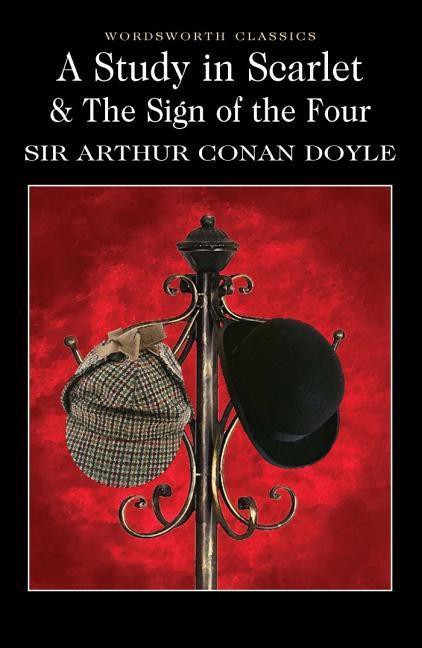
A Study in Scarlet and The Sign of the Four (Sherlock Holmes #1-2)
Genres Classic, Detective, Mystery
7/10
Dr Watson is a war veteran and on his meager veteran’s pay he’s struggling to find somewhere to live. He gets introduced to Sherlock Holmes, an excentric chemist and detective. Despite his oddities, Watson quickly finds out that Holmes’ unique skills are quite appreciated especially by Scotland Yard who calls upon him for their most difficult cases. Whilst he struggles to follow his companion’s train of thought, Watson is determined to stay by Holmes’ side to better understand his methods and record them in his book.
Highlights
- Few surprises here, it’s such a well known classic
- An oddly large number of Sherlock’s cannon is revealed in just these first two books
- Pacing has a few issues
- Definitely some antiquated takes on colonialism and ethnicity
It’s been a bit of a struggle to figure out what to write about these first two books in the Sherlock Holmes saga as they were pretty much exactly what I expected them to be, nothing more, nothing less. I was perfectly happy reading them but I also never felt enthralled by them either like I was with some other classics. Maybe part of the issue is just how well known Sherlock Holmes as a character is. Even though I didn’t specifically know these two stories, their resolution wasn’t necessarily surprising as many modern shows and movies have played on or been inspired by these.
What did surprise me is how many of Sherlock Holmes’ staples were introduced. The irregulars, Watson’s wife, Lestrade, Mrs Hudson, Wiggins, Holmes’ relationship with drugs were very quickly brought in and make recurring appearances. Given that the entirety of Holmes’ story spans a few dozen short stories, I was expecting a slower pace of bringing in new elements. However with almost all characters, tools and places already introduced, I expect all following stories to be quite formulaic. Nothing wrong with that, it works for many shows including House MD but they would probably get a bit repetitive if I were to read all of them in quick succession.
Despite the rapid pace to set up the crime scenes however, both stories resort to a similar story quirk of having a section narrating the culprit’s backstory and explain all their reasons and this takes a lot of time. In the case of A Study in Scarlet the backstory is actually also not given after having caught the culprit but rather just before. I was simply suddenly thrown into some random person’s Western style adventure without any forewarning or context meaning that for 5 consecutive chapters until it finally clicked that this was the culprit’s backstory. The Sign of the Four at least does this through the mouth of the culprit directly after they are caught, but that still left me with 1 hour long chapter of someone telling their backstory in unnecessary detail. It feels like really bad padding and breaks the otherwise fairly rapid pacing the story progresses at. It doesn’t ruin the story nor the satisfaction of Sherlock solving cases but the stories could be an hour shorter and none worse for it.
One big issue in my eyes however when it comes to puzzle solving satisfaction is that the stories are told entirely from the point of view of Watson who is not a detective in the slightest. If I were to compare this to the Sherlock Holmes movies with Robert Downey Junior, it’d be like only following Watson instead of following Sherlock Holmes, meaning we get no opportunity to really peer into Sherlock’s mind like in the “Sherlock vision” moments. It’s a stylistic choice and it works when it comes to introducing the character of Sherlock, but the problem resides in that Sherlock will sometimes simply disappear for 2 chapters, come back and say “I solved it, here’s the culprit”. Watson cannot really follow Sherlock’s reasoning nor thoughts and so as a reader we don’t really get to guess along because Watson doesn’t pick up on all the details Sherlock did until Sherlock feels like sharing his findings and conclusions. It didn’t bother me too much in these first two stories but I do worry whether this occlusion of Sherlock’s mind and the case’s facts by Watson’s cluelessness won’t get old after a couple more stories.
Finally, for the sake of acknowledging it, the book has some problematic views on slavery, ethnicity and colonialism with one pigmy character being repeatedly described as hideous and scary, not because of any specific traits outside of them being the only character of colour. I cannot really hold it against the author, the book was written in the late 1800s, racism, slavery and colonialism were still very popular at the time but it does shock a little bit.