
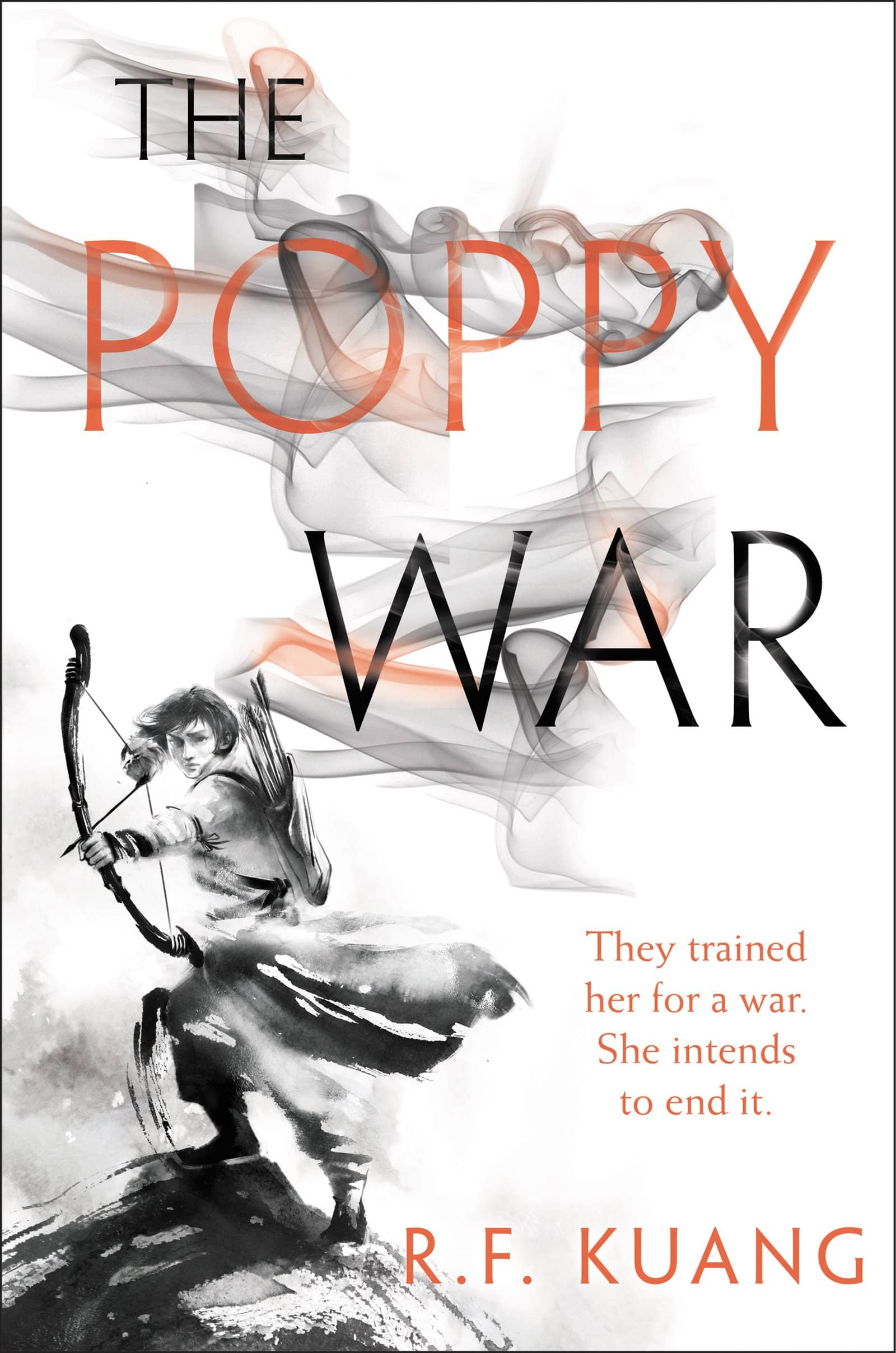
The Poppy War (The Poppy War #1)
by R.F. Kuang
Genres Young Adult, Fantasy, History
2/10
Rin is very angry that China got beat by Japan so she goes to military school where she learns to be even angrier to summon the gods, as she goes through a twisted version of the second Sino-Japanese war she eventually figures out how to become death, the destroyer of worlds. There is no bias in this blurb just like R.F. Kuang had no bias against Japan.
Highlights
- The first half is cookie cutter but decent
- Pacing is off with major time skips that hurt character development
- Barely veiled serious racism and history misconstruction issue
- I don’t see how this is Fourth Wing but better
“Fall from Grace”, the book. The Poppy War has been on my to-read list for a long time, it’s fantasy, it’s long, it’s centred on Asian mythology which I just don’t care an awful lot for, just haven’t felt like committing to it despite the acclaim for it. However, I’ve been enjoying The Empyrean recently, it’s also fantasy, it’s also long and it’s, apparently, a poorly written copycat of The Poppy War. Whilst I can attest to the poorly written bit, that had not prevented me from enjoying these books so I was excited to see their better cousin and inspiration.
It starts of promising is what really annoys me. Off the bat, similarly to The Hunger Games, we get the description of a dark and depressing China, profoundly unfair, misogynistic and ravaged by opium. Oh, sorry I meant “Nikara”, not China. Anyway a dark and depressing Nikara that is still reeling from its defeat in the previous sino-Japanese war against the Japan Empire. Oh, sorry I meant its defeat in the previous “Poppy War” against the “Mugen Empire“. Anyway, we learn that during the previous Poppy War, the conflict ended with Mugen’s genocide of the people of Taiwan which caused the British Empire to step in. Oh, sorry I meant the genocide of the people of “Speer” caused the nation of “Hesperia” to intervene. So, R.F. Kuang has a problem: for some reason they decided to have their story take place in a nondescript fantasy land where Nikara and Mugen are fighting and Speer got destroyed only to be saved by Hesperia except that there is functionally no difference between Nikara and China, Mugen and Japan etc. These countries aren’t inspired by real life, they just are their real life counterparts. Mugen, is an empire with an army of fanatics that are only too happy to die if it is for their emperor, they are a fiercely expansionist country pushed by the limited size and production capabilities of their island, they are racist, use chemical weapons and are responsible for countless war horrors including experimentation on prisoners in labs. They simply are Japan as it was during the second sino-Japanese war. I can draw up a similar web of connected characteristics for Nikara/China but you get the point: the fictional countries cannot be dissociated from their real life counterparts as they are culturally, geographically and ethnically identical. With this mind, the Mugen are described as no-nuance comically beyond Nazi levels of evil. Of course there’s the genocide of Speer to begin with which never happened historically to Taiwan. The crucial chapter however is the one where Nikara’s war capital is revealed to have been destroyed and the Mugen once again having committed genocide. It is a clear copy of the Nanjing massacre, not only are hundreds of thousands of people dead, they’ve been tortured, desecrated, raped, mutilated, the chapter is filled with gory horror. So much so that I thought it was absurd. Now, after checking a lot of the horrific deeds turned out to be true, it was a massive massacre of systematic executions but it also did involve the Japanese having competitions about kill counts, nailing of body parts on walls and trees and the cutting open of pregnant women’s stomachs whilst still alive. It is truly horrific that this happened in our History, Japan got unbelievably lucky to have been less memorable and impactful than the Nazis were in the West on top of amassing pity for being the victims of the first two atomic bombs which results in them somehow getting away essentially scot free in most western people’s memories (not so much in Asian countries though). Having said that, was it necessary to try to one up the Nanjing massacre R.F. Kuang? The massacre involved the killing of 100,000 to 300,000 Chinese people over the course of 3 months through mass shootings, decapitations and burnings and pregnant did have their stomachs cut open using knives and bayonets. So was it really and absolutely required to have the Mugen kill 500,000 Nikaran people in a couple working days through the use of gas (but still having the time to get up to all the horrific games that occured during the Nanjing massacre) and have a soldier dig into a pregnant woman’s stomach using his bare hands??? Not only did the Japanese never use gas, it also took the Nazis years to execute 6 million Jews using an industrially efficient execution process whilst the Mugen used gas in open streets to kill half a million people in 2 days whilst also still having the time to create altars of cut off fingers, nailing babies to the walls and juggling dead people’s testicles. If Mugen wasn’t called Mugen, R.F. Kuang would have been called racist and they should be. Mugen IS Japan so R.F. Kuang is actively trying to make Japan look even worse than it actually was. And as I said many times already, Japan were not the good guys and just retelling the Nanjing massacre as it was would have been horrific enough whilst keeping Japan accountable for its actions past but no instead R.F. Kuang had to make it worse for no good reason outside of barely veiled anti Japanese racism and maybe a bit of gore fetishism. The problem is that at this point, why am I reading The Poppy War? If R.F. Kuang is only presenting a distorted version of historical events then there’s plenty of good documentaries out there covering the horrors of this real conflict in a better and more accurate way. Ultimately, I read fiction for escapism, not to have to spend an hour reading up Wikipedia to brush up on my history to debunk how much this fucking book got wrong.
Alright that’s the monster paragraph about the bad history in this book, now let’s look at the bad fantasy in this book. And yes, someone could probably argue that the fake country names are because this story is fantasy and it has magic so it makes more sense for it to be in fantasy land but to that I just wanna say that certainly never stopped Harry Potter, Percy Jackson or even any of the original greek myths from taking place in our world. Tolkien and Sanderson created a brand new fantasy world for their stories because they were dissociated from the real world in almost every significant way. Nobody believes in magic in The Poppy War, at least that’s the premise. We spend the first half of the book with Rin struggling with one of her teachers Jiang because he’s master of “lore” and that’s just childish stories with no realness to them and generally speaking nobody seems to believe in magic either, one of Rin’s only friends, Kitay is characterised as being extremely well educated and profoundly rational and he simply found no evidence of magic being real. Then Rin has a fit during her combat exam, bursts into flames and discovers that Jiang was right all along and that lore is actually magic but Jiang only teaches it to those he deems worthy. Although it is odd that nobody believes in magic given that Rin drank a uterus killing potion to castrate herself and yet necrosis isn’t a concern at all. Also sometimes when punches are parried the guy standing cracks the stone below his feet, it’s very “anime” logic which is essentially magic but hey if you throw the word “ki” around it counts as physics I guess if the author is to be believed. Anyway magic is real, Rin is going to study under Jiang for her second year and oh it’s already graduation and she’s done with her studies. The book has a pacing problem. It spends 49% on Rin’s first year, 2% of Rin’s second and third years (where she’s meant to learn magic from scratch mind you) and 49% on Rin’s military career after the academy. Two problems:
1- My partner might disagree, they weren’t particularly enjoying the Harry Potter goes to school bit of the first 49% but I did and of all things Rin could learn at the academy, magic was definitely the most important one so skipping over it feels like the author just couldn’t be arsed and wanted to move on.
2- Rin’s character growth isn’t just skipped, it simply doesn’t happen.
As a reader we aren’t just stripped of learning what Rin learnt in her years 2 and 3, Rin herself is apparently stripped of that as well as her character by the end of her third year she hasn’t matured, she hasn’t learnt any military discipline, and she is virtually unchanged from her character on page 1. And whilst we’re here, I’ll mention that her character doesn’t change either by the end of the book. She starts off as a power obsessed, vengeful, naive, fanatically patriotic racist and she ends as one as well. The most annoying thing is that by looking at my notes, I point out all of her flaws at the beginning and I’m happy to see them because they give her opportunity for character growth but instead nothing changes, she’s just a shithead and that’s it and worse, she gets rewarded for it, why? Because of Japan’s history, China is justified in obtaining through Rin a Deus Ex Machina that literally nuclear bombs their entire country?
Fine, I think we need to another historical accuracy parenthesis. Historically Japan got nuclear bombed twice, in Hiroshima and in Nagasaki. As horrific as these events were, they probably cost less lives than conventional warfare would have cost to end WW2 with Japan. The targets were also specifically selected for their strategic military value. Rin in her non-changing state, eventually gets rewarded with the power of the fire god which in a “cloud of smoke resembling a mushroom” destroyed all of Mugen and I do mean all of it. Every civilian, every child, every man, every woman, every animal, every plant, every inch of the island is burnt to ash, no exception, tens of millions dead in an instant. Rin has basically no qualms with this, she has a moment of “hmm not great, did I do the right thing?” and then one of her war buddies tells her “get a grip” and she does and she’s cool with it. Also it’s a Deus Ex Machina and that sucks. There is no allied force or Mugen’s allies somewhere (maybe like Valdenreich for Nazi Germany) getting defeated, no, Mugen is winning hard on all fronts, Rin is washed up on Speer all alone, she goes to pray, gets like really really angry and the fire god gives her around 300 nuclear warheads to erase Japan from the map, done. Well it’s not technically nukes, it’s some nondescript island wide volcanic event that leads to the formation of the signature mushroom cloud but the consequences are the same, Mugen is Japan, Nikara is China and the god willed volcanic event is 300 thermonuclear bombs. And honestly it could have been bombs, the author has no real idea of what they’re doing with technology anyway. Nikara’s elite military is being taught martial arts, sword fighting and bow and arrow shooting (which weirdly Rin is wielding on the cover art despite never once shooting a bow?) whilst Mugen is rolling up with alternatively bows or guns (there is no real consistency, it’s as the authors wills it one chapter at a time), cannons, rocket launchers and cannisters of mustard gas. Yes, there was a significant difference in technology levels between China and Japan during the second Sino-Japanese war, but it also wasn’t as absurd as sticks and stones vs rocket launcher. Nikara does have one edge though, sometimes some of the Nikarans can summon gods and they do that by getting high. Speaking of getting high, have you heard of opium? Because opium is everywhere in this book, it’s so much everywhere that this book is primarily an anti Japanese racist manifesto and secondarily and anti-drug pamphlet aimed against opium addiction. Yes, China has had huge issues with opium both because of the British and the Japanese but it also really doesn’t fucking matter in this book, opium is just mentioned as flavour, it never actually matters, it could be marijuana, it could be acid, it could just crazy large amounts of caffeine, it really doesn’t matter that it’s opium outside of the fact that Nikara IS China and Mugen IS Japan.
Back to the magic that nobody believes in, Mugen attacks, Rin and her classmates are summoned to defend the administrative capital, they lose until Rin gets angry, summons the fire god, burns half the city and Mugen army and now the military leaders have to figure out what to do with her. Kitay heard the story but apparently it wasn’t told as being magic, she just kinda somehow managed to win I guess in the story that’s being passed around? Turns out all the military leaders knew that magic was real and there’s even a special force unit within the army of only people who do magic and it’s even led by Altan, Rin’s academy crush…oh yeah and one of the magic dudes literally turns into a big monkey and he doesn’t have control over it so sometimes he’s just going full ape in front of the entire army and how does nobody believe in magic again? Did I mention that Altan wields fire on the regular, that every time he fights he’s just a blurring fire tornado? In a matter of two chapters we go from nobody believes in magic, there is no evidence of magic, this world is grounded to magic is everywhere and it has always been and also realistically half the army has seen at least one magic man do magic and yet somehow nobody ever mentions to anyone ever so much so that the most educated people in the country like Kitay simply ignore the existence of it and yet all military leaders are aware of it as well but also they disrespect “lore” and don’t really think magic is a particularly powerful thing except that Rin can bomb out a country of existence? I can keep going but it simply does not make sense in any shape or form, I have no idea why R.F. Kuang decided to go the “magic isn’t real” premise outside of trying for the most predictable and boring pseudo-twist I’ve ever seen. Also I don’t know where else to say but Altan’s godly fire is some unbeatable power for 90% of the book and in the last 4 chapters we learn that you can cancel all his powers by throwing a singular bucket of water at him. You. Cannot. Make. This. Shit. Up.
Anyway, magic is real, Rin is part of the elite troupe now and…and…she’s going on her first mission…immediately? Rin at this point of the story only summoned her fire magic twice and both times it was a complete accident and she has no idea how to do it especially without getting high off her ass on drugs. Nevertheless, Altan thinks it’s the right call to have her come along on a critical, deadly mission on her first day. She can’t summon the fire, she decides to get high to try again, fails again, and now she’s just very high in a life or death combat situation and I can’t help but think, some form of onboarding, training, or simply not getting high and fighting straight on would have been the better strategy. But it’s ok because pretty boy Altan saves her and how lovely he is aaaaaand he’s an emotionally and physically abusive fuck and we are most certainly never gonna deal with that, Altan is justified in his abuse of Rin and Rin agrees and that’s the morale. Early on in the book I was hoping for a romance between Altan and Rin, they are unified by both being from Speer, but Altan’s just toxic and Rin is way too far into her blind fanatic patriotism to have any room for romance of any sort anyway. Anyway, after that operation that almost got Rin killed, Altan tries teaching her, he fails, he gets angry, he abuses her and he sends her off to kill a magic demon that’s killing hundreds of civilians (who do not believe in magic so I don’t know why they believe that the demon is killing them) and it goes really poorly with Rin falling into the most obvious trap I’ve ever seen until Rin gets angry and she barely wins. That’s still not enough though, on the whole Nikara is losing, their war capital is destroyed and its population eradicated (except for a few thousand who are in the care of Altan’s troupe…with no logistics…no idea how they get food or water but whatever) and Altan gets reaaaallly depressed now and smokes up some opium and Rin sees it and amongst the rape of her academy friend, the dismembered babies, the nailed up hands on doors and the grotesque display of men having their cut-off penises shoved into their mouths, Rin only really gets upset at Altan having a smoke to get just a moment of peace from having so utterly lost the war.
Sigh
Opium’s bad, I get it, but in the grand scheme of things, I think Altan having a smoke or even Altan being addicted to Opium really isn’t as bad a half a million dead people and raped children but maybe I got my priorities weird. Also why is Rin so good with dealing with the horrors of war? She grew up in the countryside, never seen anything of war and yet none of the goriness, stress of battle, danger of death get to her, she is just completely indifferent to suffering. She does get a couple lines of getting really angry (yes again) about the injustice of Mugen’s treatment of Nikara but in the moment not a peep, she just does not care.
Altan comes back from his smoke break and he’s got a great idea, he’s going to reawaken the prisoners of the mountain to mount an army of revenge. Turns out that if you have magic powers, you can’t die anymore (well except Altan who does die like 3 chapters after we establish that magicians can’t die) so when your mind breaks from all the godly influences you get stored under a big mountain for all eternity. Sounds fair on paper doesn’t it? People get power through gods, they get partially inhabited by the gods which makes them immortal but also makes them go insane so they need to be imprisoned before they destroy the world. Now what if I told you that actually people had tried killing these these demi gods by cutting them into many pieces but then the pieces kinda just gravitated towards each other and reform the body so instead of keeping the pieces in a couple different boxes they just store the full person under a mountain? That would sound ridiculous and yet that’s what the book does, they could have just done an Achilles thing where fate just keeps them alive on way or another like Achilles seemingly never gets hit by any weapon or arrow (it’s not like he gets impaled repeatedly and just doesn’t care because that’d be dumb) but no the author had to over-explain it and make it sound stupid. Everyone thinks Altan’s plan is dumb because the people in that prison have been there sometimes for up to 500 years and so after so much time they’re probably not gonna be in a helpful mood but Altan is determined and Rin is gonna follow because he’s beaten her enough now that she is stronger and believes in him. Altan and Rin ride for a few days towards the mountain, they don’t appear to be followed, they hike up the mountain, still not followed, they get inside, liberate a guy who goes completely insane, tries to kill them both and runs (how predictable was that) and then after about 30min within the mountain, the Mugen show up with a full army and arrest them (I don’t know how you can’t see the full column of armoured soldiers following you up a mountain barely 30min behind you).
We get some other twist on Japan’s Unit 731, with a doctor wearing a white doctor’s garb and has white hair and his name is Dr Shiro (that’s Dr White but in Japanese). Altan and Rin get super mega angry this time and escape, Altan commits suicide by fire, Rin swims off, gets nukes, decides that after killing almost 80 million Mugen, she now wants to kill Nikara’s empress (and whatever army stands in the way) because she betrayed at some point apparently, the end.
I had an unironic good time with the good for the first 49%. When everything was still getting set up and I was theorising about where the story would go it was well written enough. Characters were interesting and they were sort of nuanced, there were clear opportunities for development, clear suggestions at the evolution of interpersonal relationships and there were even some decent funny bits. Even though it wasn’t my partner’s thing, I did also enjoy the very formulaic, first year of teaching, the introduction of the classes, the different teachers, the challenges, the exams, it’s cookie cutter but it’s fun. Then the author essentially skipped over year 2 and year 3, forgot about magic being something nobody believes in because there was no evidence anywhere of it, refused to develop Rin in any way, embraced abuse, misconstrued real world History, potentially for racist purposes or maybe just lazy shock factor and closes out the story with a Deus Ex Machina. It’s objectively better written than Fourth Wing from a grammatical and style point of view but it’s thematically much much worse.